I have been using the free tier of a particular service for a while now. The service is very good and does its job well. But it has very ridiculous limitations/restrictions on its free tier. The most annoying of them all is the inability to receive notifications via anything but email unless you upgrade.
I wanted to upgrade to one of the service’s paid tiers, but all the tiers have features that I don’t need and limits that exceed anything that I would ever use in a lifetime.
So, I decided to do something different.
Given that the service allows notifications via email on the free tier, couldn’t I somehow intercept those emails, parse them, extract the information I need, and then send it to the service of my choosing?
I could indeed!
My journey began by using Gmail’s email filters, n8n, and Pushover. When I would receive an email from the service, I would give it a label, mark it as read, and then, in n8n, I used an “On message received” trigger + a “Code in JavaScript” action to extract the information I needed from the email using string manipulation and finally a “Push a message” action to, well, push a notification to my devices.
That worked OK, but there was a problem: the “On message received” trigger uses polling with a 1-minute poll interval. That meant it would take at least 1 minute for the trigger to fire.
I wanted instant notifications.
So, I started looking online for email webhook services. Basically, services that give you a mailbox that, whenever an email is received, a webhook is triggered with the raw/parsed email content.
I found many such services, including:
But they all either:
- Had no or lacklustre free tiers.
- Had expensive paid tiers or no usage-based billing.
I don’t want to pay for something I know I won’t be using much, nor do I want to keep working around restrictive free tiers.
So, I decided to create my own!
I won’t go into detail here, but basically, I looked up the relevant SMTP RFCs (which are https://www.rfc-editor.org/rfc/rfc5321 and https://www.rfc-editor.org/rfc/rfc7504 for anybody wondering) and, using Go, I implemented a simple inbound-only email server that would receive emails, parse them, log them in an NDJSON file, and fire webhooks depending on which mailboxes the email was intended for.
It took me a couple of Fridays as I wasn’t in a hurry, but it was a pretty straightforward process.
Oh, and the reasons I chose Go over something like Node.js or Bun are mainly binary size and the standard library’s richness. I had to use exactly zero dependencies, since Go’s stdlib had everything I needed, and the binary size was ~6.5 megabytes.
So, now, for example, I was able to send emails to [email protected] and that would trigger an n8n webhook that would parse the raw email content (using postal-mime) and create a to-do in whatever service I used for that, using whatever the parsed email contained.
And, sticking to the free-everything theme, I hosted the email server on a small, old laptop I had lying around at home.
Back to the OG problem.
I was now able to replace the “On message received” trigger with a webhook trigger in n8n, set up the service I use to send emails to a specific fake mailbox instead of my Gmail, and voila! Whenever the service sent an email, the server would trigger the n8n webhook, parse the email, and send a Pushover notification!
I achieved mostly what I needed: instant (or as instant as email allows) notifications, completely for free.
But the entire thing wasn’t actually 100% free; I was still using Pushover, which offers a 30-day trial and is relatively cheap at USD 5 (one-time) after that.
You might think that I would pay the 5 bucks and get it over with, but you’d be wrong!
Again, using Go, I wrote a web API with two endpoints: one to establish an SSE connection and another to send a notification to one or more connected SSE clients.
And using Jetpack Compose, I quickly wrote an app that connected to the web API and pushed notifications whenever it received a server-sent event.
Surprisingly, of all the things I had done so far, the most difficult and annoying part was dealing with the mind-numbing number of limitations and gotchas around background/foreground services on Android. Still, since this is an app for me only and I control all the devices on which it will be installed, I got it working without issues for the most part.
So the final pipeline became: service email → my self-hosted inbound email server → n8n webhook → my tiny notification API → my Android app via SSE.
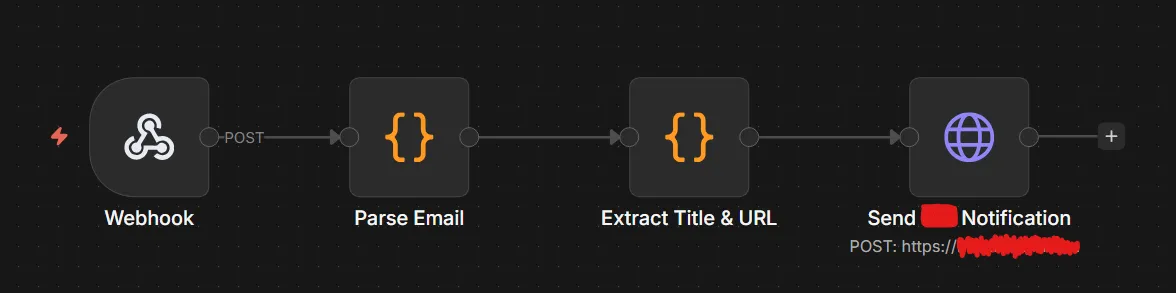
This is a completely reasonable and proportionate solution to the problem of not wanting to pay for a higher-tier plan.
Did I spend far more time building this than the upgrade would have cost me? Almost certainly. But that was never really the point. The point was that I didn’t want features I wouldn’t use, limits I didn’t need, or yet another subscription for something so small. I wanted a solution that fit my use case, and in the process I ended up with a bunch of small, reusable tools: an inbound email server, a lightweight notification system, and a better understanding of SMTP, webhooks, and Android background execution.
So yes, this started as a way to get free instant notifications. But it also became a reminder that sometimes the best side projects come from mild annoyance, stubbornness, and the refusal to accept “just upgrade” as the only answer.